What Happened
Thirty years after one of the deadliest aviation disasters in American history, families gathered on Long Island to remember the 230 lives lost when TWA Flight 800 exploded in midair off the coast, according to CBS New York. The Boeing 747 departed John F. Kennedy International Airport on July 17, 1996, bound for Paris, and broke apart just 12 minutes into its flight. All 230 people on board died, cementing the crash as one of the worst aviation accidents in United States history.
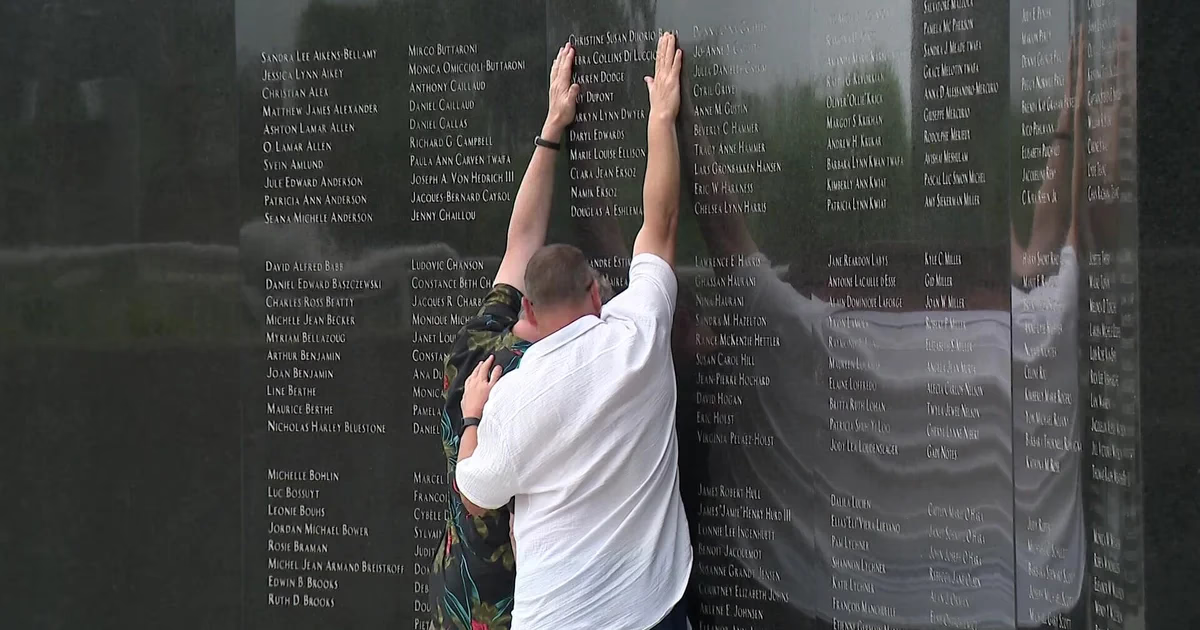
A memorial service was held Friday, July 17, 2026, at 7:45 p.m. at the TWA Flight 800 International Memorial in Shirley — the precise time the tragedy unfolded three decades earlier. Suffolk County Executive Ed Romaine addressed those assembled: “We are here tonight to remember them, to pray for their souls.” The service drew victims’ families from around the world, united by grief that, even after 30 years, shows no sign of fading.
Among those attending for the first time this year was the Bailey family, who traveled from England. Christine Diiorio-Bailey and her husband Pietro were not originally booked on Flight 800. As her brother Ian Bailey recounted to CBS New York, Christine “was supposed to go direct from New York to Rome, and that plane got cancelled and she got transferred to Paris.” In a haunting detail, Ian Bailey noted: “Her luggage got home.” Reflecting on the loss, he said simply, “We just couldn’t believe it. We couldn’t believe it. No way.”
The 230 victims came from 14 nations and included 16 students from a Pennsylvania high school French club traveling abroad. Suffolk Legislator and former television reporter Trish Bergin, who witnessed the immediate aftermath firsthand, described what first responders encountered when they reached the water: “The water was completely on fire, and there was just debris and personal items and victims.” Suffolk County Executive Romaine, reflecting on the shock that gripped the region at the time, recalled the questions that immediately arose: “What would bring down a jet right after it had taken off at Kennedy? There was a lot of concern.”
The investigation that followed was one of the most exhaustive in aviation history. Witnesses had reported seeing what appeared to be a fiery streak rising toward the plane, igniting intense speculation about a possible missile strike or deliberate sabotage. Investigators undertook the painstaking reconstruction of the 747 from more than 1,000 pieces of wreckage pulled from the ocean floor, assembling the shattered fuselage like a giant puzzle. On November 18, 1997, then-FBI Assistant Director James Kallstrom announced the findings definitively: “Two, there was no evidence of an explosion of a missile warhead. Three, there was no evidence of missile impact.” The cause was ultimately determined to be a spark that ignited explosive gas in the aircraft’s center fuel tank — a finding that drove sweeping changes to aviation fuel tank safety standards across the industry.
Location & Road Context
The disaster occurred in the Atlantic Ocean off Long Island’s South Shore, minutes after the plane climbed out of JFK. The TWA Flight 800 International Memorial, the permanent gathering place for survivors and families, is located in Shirley, a hamlet in Suffolk County along the South Shore. The memorial was built by the same community whose first responders were first on scene in 1996 — a testament to the enduring connection between Long Island and this tragedy. For more on Suffolk County roads and travel conditions, visit our roads section.
Investigation & Legal Proceedings
The investigation into the cause of the explosion was conducted jointly by the FBI and the National Transportation Safety Board and spanned more than a year. As CBS New York reported, theories of missile strike and sabotage consumed early stages of the inquiry, driven in part by eyewitness accounts of a streak of light ascending toward the aircraft. Those theories were conclusively ruled out by November 1997, when Assistant FBI Director James Kallstrom confirmed no evidence of high-explosive damage, no missile warhead detonation, and no missile impact had been found. The NTSB ultimately attributed the explosion to a fuel-air ignition in the center wing fuel tank. The findings prompted the Federal Aviation Administration to mandate significant changes to fuel tank design and safety protocols across commercial aviation fleets.
Broader Impact
The reconstruction of TWA Flight 800 — more than 1,000 pieces of wreckage reassembled in a hangar — became a landmark forensic effort that directly shaped the safety standards governing commercial aircraft fuel systems. The aviation fuel tank reforms that followed the NTSB’s findings have been credited with meaningfully reducing the risk of similar catastrophic in-flight explosions in the decades since. For Long Island, the crash remains a defining collective trauma, with the Shirley memorial standing as a permanent reminder of the community’s role in both the immediate response and the long road toward answers.