What Happened
State Sen. Monica R. Martinez announced on July 16, 2026, that New York’s Department of Transportation has applied for federal funding to develop grade crossing elimination concepts at three notoriously congested Long Island Rail Road crossings within her district, according to a report by LongIsland.com.
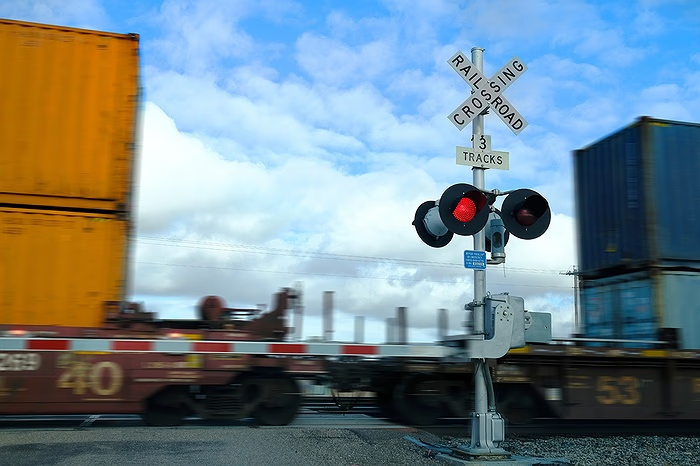
The three crossings targeted in the application are located along the LIRR’s Ronkonkoma Branch in Suffolk County: Straight Path, Wicks Avenue/Fifth Avenue, and Lowell Avenue. All three fall within the Fourth Senatorial District and are situated inside developed communities that include nearby passenger rail stations, signalized intersections, and regional roadways. As LongIsland.com reported, the crossings are a “hot-button issue” for local residents, who are frequently delayed by passing trains — delays that affect not just everyday motorists but also emergency responders trying to reach people in crisis.
The scale of the problem is illustrated by the traffic volumes involved. Combined, more than 63,000 vehicles use the three at-grade crossings per day. Wicks Avenue/Fifth Avenue alone sees over 35,000 vehicles daily, placing it among the top five busiest grade crossings on Long Island. Meanwhile, the LIRR’s Main Line — which includes the Ronkonkoma Branch — is estimated to carry more than 120 weekday passenger trains in addition to rail freight, meaning gate-down time at these intersections is substantial and recurring throughout the day.
The funding request was submitted under the Railroad Crossing Elimination Grant Program, a competitive $1.1 billion federal initiative administered by the Federal Railroad Administration. The program supports projects that build overpasses or underpasses to physically separate motor vehicle and train traffic, upgrade safety technology at existing crossings, relocate tracks, or fund public education on railroad safety. New York DOT filed its application ahead of the June 8 program deadline.
Sen. Martinez made clear that the stakes extend well beyond commuter frustration. “With each train’s crossing comes an inconvenience, and in emergency situations, a threat to those who are slowed from getting the critical help they need,” she said in a statement reported by LongIsland.com. “I urge the Federal Railroad Administration to give full consideration and support to this highly anticipated planning effort. Funding will address longstanding community concerns while providing significant benefits to the residents of Suffolk County. I thank our federal partners for considering this important investment in our region and nation’s critical transportation infrastructure.”
If the grant is approved, the money would not immediately break ground on new structures. Instead, it would fund the planning and environmental review work necessary to evaluate and prepare long-term grade separation solutions — the detailed preliminary steps required before overpasses or underpasses can be designed and built. According to the announcement, the effort builds on prior coordination and investments already made along this corridor, and the planning work would provide the foundation needed to eventually implement the full crossing eliminations.
Location & Road Context
The three crossings — Straight Path, Wicks Avenue/Fifth Avenue, and Lowell Avenue — all sit along the LIRR’s Ronkonkoma Branch in central Suffolk County, a rail corridor that serves as one of the busiest commuter rail lines in the United States. The surrounding communities are densely developed, with passenger rail stations, signalized road intersections, and regional roadways in close proximity, all of which amplify the ripple effect of each train passage on local traffic flow. At-grade crossings of this type, where road and rail share the same level with no physical separation, are among the most operationally disruptive and safety-sensitive points on any rail network, particularly on a line running 120-plus passenger trains per weekday alongside freight traffic.
Broader Impact
The Railroad Crossing Elimination Grant Program represents one of the few federal funding streams specifically designed to address the kind of chronic, infrastructure-level congestion that at-grade rail crossings impose on communities. For Suffolk County residents living near these three crossings, the outcome of this application will determine whether the long-discussed vision of grade-separated crossings moves from concept to concrete planning — and eventually to construction — or remains on hold. Emergency response delays caused by lowered crossing gates are a documented concern nationwide, and the dense suburban character of the Ronkonkoma Branch corridor makes these three locations particularly high-priority candidates for the type of overpass or underpass solutions the federal program is designed to fund.