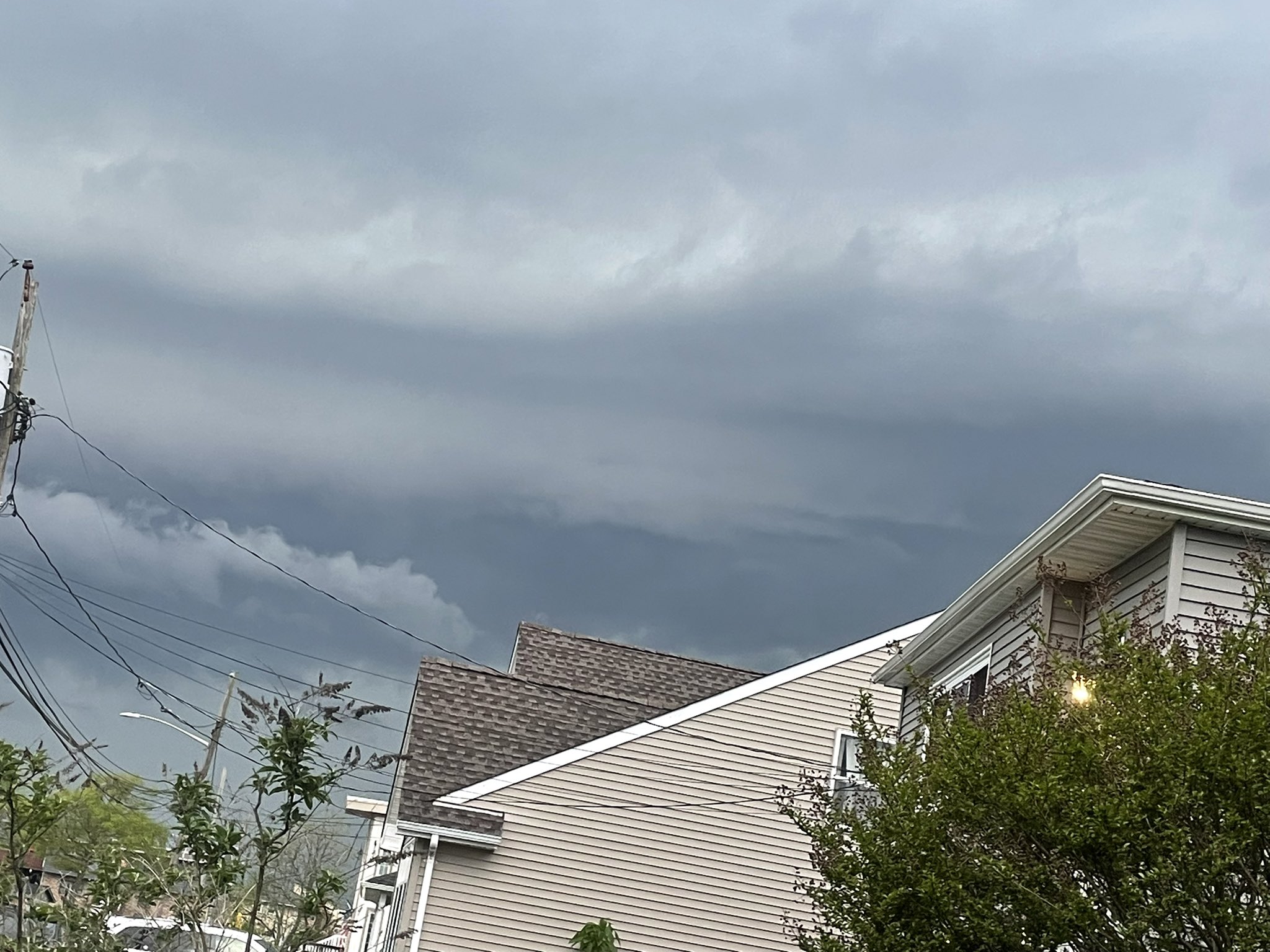
PHOTOS + VIDEO: Massive Shelf Cloud Rolls Over Long Island — 'Haven't Seen One Like This Probably Ever'

A dramatic shelf cloud formation preceded tonight's severe thunderstorm as it crossed Long Island. Video and photos capture the ominous wall of cloud signaling 60 mph winds, hail, and flash flooding now hitting Nassau and Suffolk Counties.

Updated May 20, 2026
MAJOR INCIDENT
Reported
Source
Editorial
PHOTOS + VIDEO: Massive Shelf Cloud Rolls Over Long Island — 'Haven't Seen One Like This Probably Ever'

May 20, 2026 — 8:35 PM. The severe thunderstorm that flooded Brooklyn and Queens this evening announced its arrival on Long Island with a rare and dramatic shelf cloud — a low, horizontal, wedge-shaped cloud formation that signals the leading edge of a powerful storm’s outflow boundary.


The Shelf Cloud
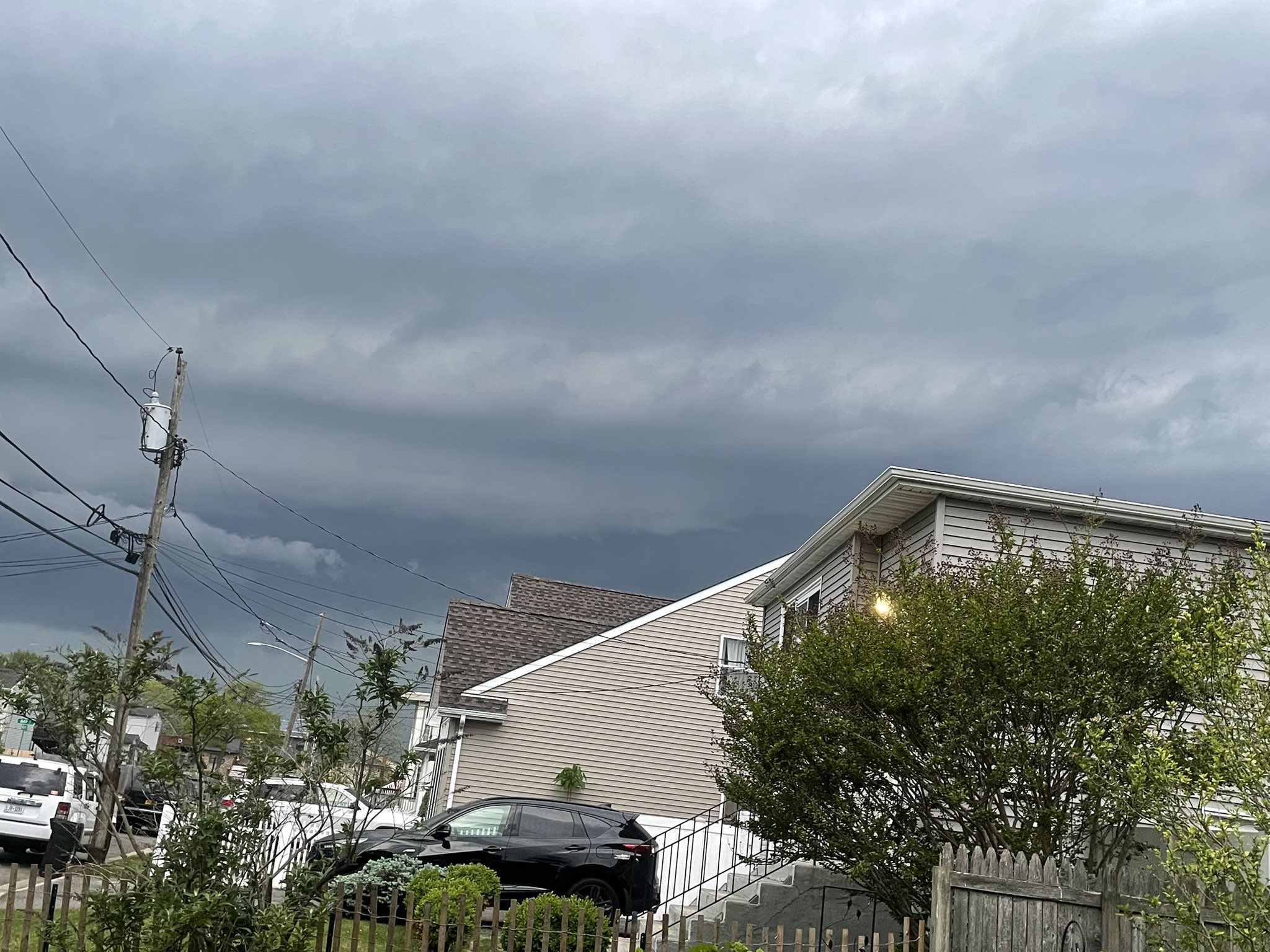
Massive shelf cloud rolling over Long Island ahead of severe thunderstorm

Second angle of the Long Island shelf cloud formation

Source: @JRealMedia on X“Haven’t seen a shelf cloud like this on Long Island probably ever”


What Is a Shelf Cloud?

A shelf cloud (or arcus cloud) forms along the gust front — the leading edge of cold air rushing out from a thunderstorm’s downdraft. When this cold, dense outflow slides beneath the warmer, moist air ahead of the storm, the warm air is forced upward rapidly, condensing into the dramatic wedge-shaped cloud visible in these images.

What a shelf cloud tells you:

  • Severe wind is imminent — the gust front that creates the shelf cloud carries the storm’s strongest wind gusts. Tonight’s storm has 60 mph gusts.
  • Heavy rain follows within minutes — the shelf cloud marks the boundary between dry air ahead and the storm’s main precipitation core behind it
  • The storm is intensifying — well-defined shelf clouds indicate strong, organized thunderstorm cells with sustained updraft/downdraft cycling
  • Hail is possible — tonight’s NWS warning includes penny-sized hail

How Rare Is This?

Long Island’s geography — a narrow, flat, 118-mile-long island surrounded by ocean on three sides — doesn’t typically produce the dramatic shelf cloud formations seen in the Midwest, where flat plains and extreme temperature gradients create more photogenic storm structures. When a Long Island resident says “haven’t seen one like this probably ever,” that’s a credible observation — this formation requires an unusually powerful storm cell moving across the island’s flat terrain with the right temperature and humidity conditions.


What’s Happening Now

As of 8:35 PM EDT, this storm cell has crossed from Brooklyn and Queens into western Nassau County and is pushing eastward. Based on the storm path:

TimeLocationExpected Conditions
8:00–8:30 PMWestern Nassau (Hempstead, Garden City, Mineola)Heavy rain, 50-60 mph gusts, possible hail
8:30–9:00 PMCentral Nassau (Levittown, Massapequa, Farmingdale)Peak intensity rainfall, flash flooding
9:00–9:30 PMNassau/Suffolk border (Melville, Huntington, Babylon)Heavy rain, diminishing winds
9:30–10:00 PMCentral Suffolk (Brentwood, Islip, Patchogue)Moderate to heavy rain
10:00 PM+Eastern SuffolkTrailing showers, clearing

⚠️ The LIE sinkhole at Exit 49 in Melville — repaired just last week after a 10-foot sinkhole swallowed a car — sits directly in this storm’s path. Additional rainfall on recently repaired pavement over a known subsurface weakness is a concern.


Tonight’s Full Storm Coverage

Storm watch continues through 6 AM Thursday.


Sources

Topics

shelf cloudsevere thunderstormLong IslandweatherNassau CountySuffolk CountyNWSstorm photosdramatic weathershelf cloud Long IslandLong Island severe thunderstorm photosLong Island storm cloud video

Frequently Asked Questions

What should I do if I'm in a car accident on Long Island?

Call 911 immediately if anyone is injured or if the vehicles can't be moved safely off the roadway. Stay at the scene — leaving the scene of an accident with injuries is a crime under New York Vehicle and Traffic Law §600. Exchange license, registration, and insurance information with every other driver involved. Take photographs of every vehicle, the position of the vehicles before they're moved, all license plates, the road surface, traffic signs, and any visible injuries. Get the names and phone numbers of every witness — police often won't capture bystander witnesses on their own. Seek medical attention within 24 hours even if you feel fine; soft-tissue injuries and concussions can take a day or two to present, and a delayed medical visit weakens an injury claim. In Nassau County, NCPD responds outside of incorporated villages. In Suffolk County, SCPD covers the five western towns; East End towns have their own forces. New York State Police Troop L responds to accidents on state highways across both counties.

How long do I have to file a no-fault claim in New York?

Thirty days. New York Insurance Law §5102 requires you to file a Personal Injury Protection (PIP/no-fault) application with the insurer of the vehicle you were in (or, if you were a pedestrian or cyclist, with the insurer of the striking vehicle) within 30 days of the accident. Missing the 30-day deadline can void your no-fault benefits — that's up to $50,000 in medical bills and 80% of lost wages (capped at $2,000/month) per injured person. The form is the NF-2 application; your insurance carrier provides it on request. New York no-fault is a true PIP system: it pays regardless of who caused the crash.

What counts as a "serious injury" under New York law?

Under Insurance Law §5102(d), a "serious injury" is one that meets at least one of these categories: (1) death; (2) dismemberment; (3) significant disfigurement; (4) a fracture; (5) loss of a fetus; (6) permanent loss of use of a body organ, member, function, or system; (7) permanent consequential limitation of use of a body organ or member; (8) significant limitation of use of a body function or system; or (9) a medically determined injury that prevents the injured person from performing substantially all daily activities for at least 90 of the first 180 days following the accident. Only injuries that meet one of these nine categories create the right to sue the at-fault driver for pain and suffering damages — short of that threshold, recovery is limited to no-fault PIP benefits. Disputes over whether an injury meets the threshold are the single most-litigated issue in NY motor-vehicle cases.

How long do I have to sue after a Long Island car accident?

Three years from the date of the accident for personal injury claims under CPLR §214(5). Wrongful death claims have a two-year deadline under EPTL §5-4.1. If a government entity is involved (a county vehicle, a road defect on a state highway, a defective traffic signal, a county bus), you must file a Notice of Claim within 90 days under General Municipal Law §50-e — that's a non-negotiable jurisdictional deadline, and missing it usually bars the claim entirely. Property-damage-only claims have the same three-year clock. The clock starts on the day of the accident, not the day you discover the full extent of an injury.

Can I still recover compensation if I was partly at fault?

Yes. New York is a pure comparative negligence state under CPLR §1411. Even if you were 90% at fault, you can still recover 10% of your damages. (A pending 2026 budget proposal would change this to a 51% bar — meaning a plaintiff who is more than 50% at fault would recover nothing — but that hasn't passed.) Insurance carriers routinely try to inflate the injured driver's percentage of fault to reduce payouts. The percentage assignment is decided by the jury at trial (or negotiated during settlement); it isn't fixed by the police accident report and isn't binding even when the report assigns fault. Reporting practice and the actual legal apportionment are separate questions.

How do I get a copy of the police accident report?

If local police responded to the scene, the report is filed under an MV-104A form. In New York State, you can request a copy through the DMV at https://dmv.ny.gov/vehicle-safety/get-copy-accident-report (roughly $7 online, $10 by mail) once the responding agency has uploaded it to the state system, which usually takes 5-10 business days. NCPD and SCPD also have their own direct-request processes through the precinct that responded. If you weren't injured but the property damage exceeded $1,000, New York VTL §605 requires you (the driver) to file your own MV-104 report with the DMV within 10 days regardless of whether police responded.

Disclaimer: Incident information on this page is compiled from public sources including police reports, traffic agencies, and news outlets. It is provided for informational purposes only and may not reflect the most current status of this incident. Do not rely on this information for legal, insurance, or emergency decisions. For emergencies, call 911.