Updated 11:30 AM — Friday, May 22, 2026. LaGuardia’s Runway 4/22 closure has been extended through at least Saturday morning after ground-penetrating radar found additional “areas of concern” on the airfield. The Port Authority now expects to complete surveys and repairs by 6 AM Saturday, May 24 — eating into Memorial Day weekend. Over 150 delays and 6+ cancellations already Friday morning. This comes as forecasters warn of the wettest Memorial Day weekend in 78 years.
Friday Update: Runway Closure Extended — Ground-Penetrating Radar Finds More Problems
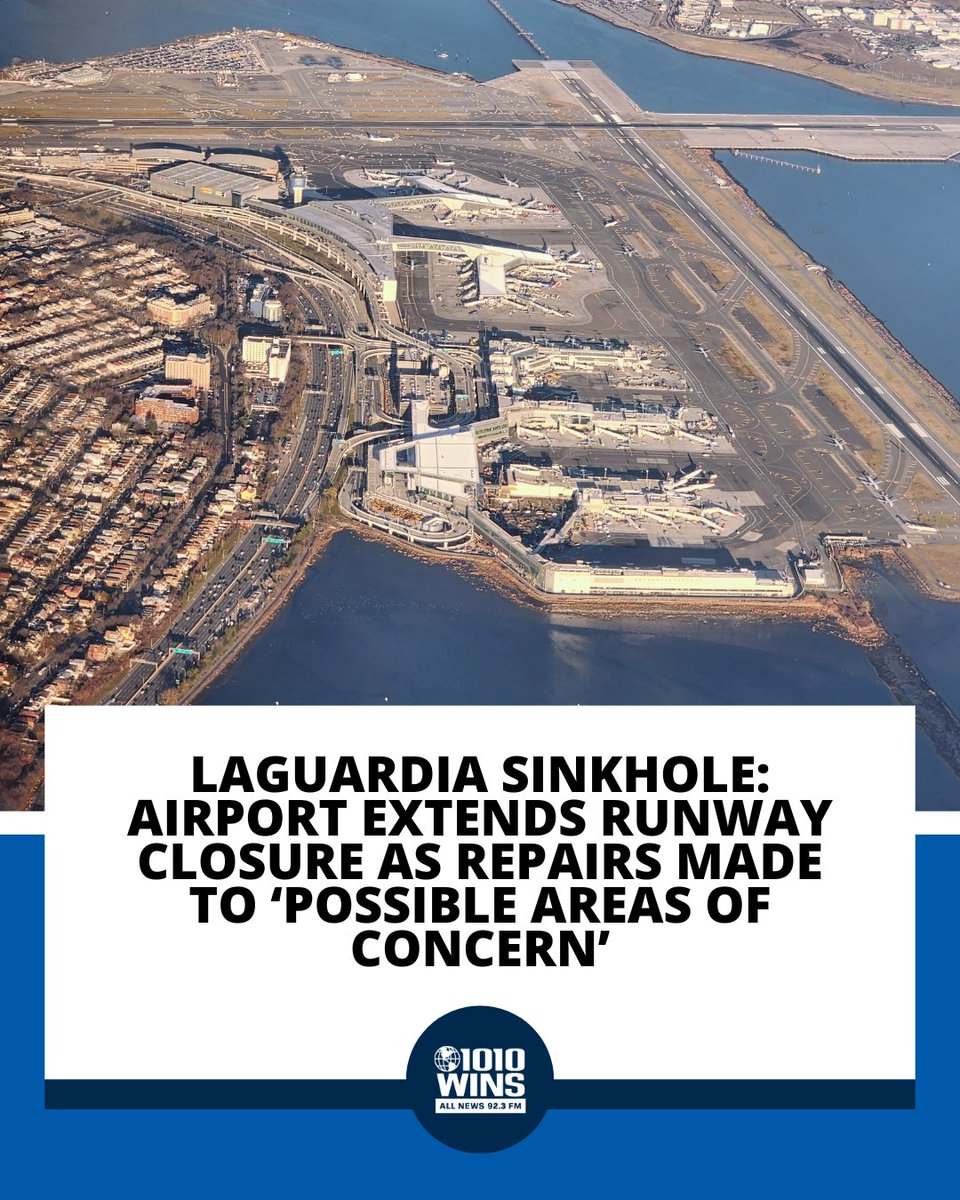
Source: 1010 WINS / Brendan Walsh via iStock/Getty Images Plus
The Port Authority announced Friday morning that what was supposed to be a Thursday reopening has been pushed to Saturday at 6 AM at the earliest:
“During investigatory inspections of LaGuardia’s airfield pavement Thursday using ground-penetrating radar, possible areas of concern were identified and proactively repaired. Out of an abundance of caution, engineering crews are conducting additional inspections that necessitate the continued closure of Runway 4/22.”
Translation: They pointed radar at the ground around the sinkhole and found more instability. The original sinkhole wasn’t an isolated failure — it’s part of a broader subsurface problem, exactly as geotechnical engineers have warned about LaGuardia’s reclaimed marshland foundation.
As of 9:30 AM Friday, FlightAware reports over 150 delays and 6 cancellations at LGA — and the heavy rain hasn’t even started yet. Saturday and Sunday’s forecast of 2–4 inches could further complicate the reopening timeline.
Key question nobody is answering: If ground-penetrating radar found “areas of concern” around one sinkhole, have they scanned the entire airfield? Or just the immediate vicinity of Runway 4/22?
Original reporting from May 20–21 below:
May 20, 2026. What began as a Wednesday morning sinkhole discovery at LaGuardia Airport has cascaded into a pre-Memorial Day travel catastrophe. Runway 4/22 remains closed until at least Thursday morning. The overnight severe thunderstorm is now compounding single-runway operations, triggering hundreds of cancellations and delays that are rippling across the country. Long Island travelers face a brutal Thursday.
The Double Hit: Sinkhole by Day, Storm by Night
LaGuardia Airport is running on one runway heading into one of the busiest travel weekends of the year — and now it’s doing so in the dark, in a thunderstorm.
The sinkhole that appeared near Runway 4/22 during a routine morning inspection Wednesday at 11:00 AM was already a serious disruption. By the time the severe thunderstorm that pummeled New York City, Brooklyn, Queens, and Long Island with 60-70 mph winds and flash flooding arrived Wednesday evening, it hit an airport already operating at half capacity.
The Port Authority confirmed Runway 4/22 will remain closed until Thursday morning, May 21. With the overnight storm reducing visibility, triggering lightning holds, and further squeezing what a single-runway operation can absorb, the damage is compounding rapidly.
As of 4:00 PM Wednesday — before the storm even hit — 101 flights to LaGuardia had already been canceled and 139 more were delayed, according to FlightAware. That number has climbed through the evening as storm-related Ground Delay Programs restricted the flow of inbound aircraft even further.
National Ripple: Chicago, Atlanta, Dallas Hit
LaGuardia’s disruption doesn’t stay at LaGuardia. The airport occupies a unique position in the U.S. flight network as a major East Coast hub serving some of the country’s most heavily traveled routes. When LGA goes down to one runway during peak operations, the math is unforgiving: less throughput means more holds, holds mean delayed aircraft, and delayed aircraft means every downstream connection in every carrier’s network falls behind.
The ripple has already spread to Chicago O’Hare, Atlanta Hartsfield-Jackson, and Dallas-Fort Worth — three of the country’s four busiest hub airports. Passengers on connecting itineraries through LGA are arriving late to connections, or not arriving at all.
For Long Islanders who drive to LaGuardia rather than JFK, this creates a decision point tonight and Thursday morning: stay the course and expect significant delays, or pivot to JFK (which has not reported comparable infrastructure issues) and accept the longer airport experience.
The Runway Itself: A Haunted Strip of Tarmac
There is a reason Runway 4/22 carries particular symbolic weight in the current news cycle. This is the same strip of asphalt where, in March 2026, an Air Canada jet collided with a Port Authority fire truck while landing — a crash that killed both pilots and injured dozens of passengers. The March incident triggered an FAA investigation into LaGuardia’s ground traffic management protocols and the coordination between tower and operations crews during fire response.
Now, two months later, the same runway is again at the center of a crisis — this time with the ground literally giving way beneath it. The Port Authority has not yet announced a cause for the sinkhole, but multiple infrastructure analysts have pointed to LaGuardia’s geological reality: the airport was built on reclaimed land adjacent to Flushing Bay and Bowery Bay, on ground that was literally marshland and tidal flats a century ago. The subsurface below the airport is a patchwork of fill, sediment, and engineered support structures that have been under continuous stress from aircraft loads for 80-plus years.
The severe storms hitting the region this spring — including tonight’s — accelerate subsurface water movement and can undermine the soil stability beneath aging infrastructure. Geotechnical engineers familiar with the airport’s construction history have long flagged the fill layer as a latent vulnerability. Tonight’s heavy rain, falling on an airport already managing a sinkhole repair, is not a neutral variable.
What Long Island Travelers Need to Know Right Now
If You’re Flying Through LaGuardia Thursday Morning
The runway is expected to reopen by 10 AM Thursday, per NBC New York. That’s a best-case estimate made before the overnight storm added construction complexity. Treat it as an optimistic floor, not a guaranteed ceiling.
What to do:
- Check your airline app first thing Thursday morning — many carriers have issued travel waivers that allow free rebooking to Friday or Saturday
- If your airline has issued a waiver, use it proactively rather than waiting standby in a chaotic terminal
- If you must fly Thursday, arrive at least 2.5-3 hours early and factor in the storm’s effect on Queens road access — the Belt Parkway and Van Wyck Expressway approaches to both LGA and JFK can flood
- JFK is a viable alternative for many LGA routes — American, Delta, and United all maintain JFK service to most domestic destinations; compare options on your carrier’s app
The Memorial Day Factor
The Port Authority was already warning of over 2 million passengers expected through New York area airports over the Memorial Day weekend before the sinkhole or storm entered the picture. With one runway at capacity-constrained LaGuardia, that volume simply cannot move at its planned rate. If the runway reopens Thursday morning as promised, there will still be a backlog to clear before normal scheduling can resume.
Airlines are already over-booked across the weekend. Any additional delay to Thursday operations — including weather holds from residual storm activity — creates a structural shortage of aircraft and crews heading into the weekend.
Bottom line: If you can be flexible on Memorial Day weekend travel, even shifting by one day can dramatically reduce your exposure to this backlog.
Long Island Is Ground Zero for Travel Disruption This Week
It’s worth stepping back and naming what this week has become for Long Island and the greater New York region. In less than seven days:
- May 14: A sinkhole on the Long Island Expressway in Melville, approximately 10 feet wide and 8 feet deep, swallowed a car and closed westbound lanes
- May 16-19: The first LIRR strike since 1994 shut down commuter rail service for 300,000 daily riders over four days
- May 19, noon: LIRR service restored, with full service resuming at 4 PM
- May 20, 11 AM: LaGuardia Runway 4/22 shut down after sinkhole discovered; 101+ flights canceled, 139+ delayed
- May 20, ~3 PM: A school bus carrying 39 children became trapped in a sinkhole on East 180th Street in the Bronx; no injuries
- May 20, 6:28 PM: NWS issues Severe Thunderstorm Warning for Brooklyn, Manhattan, Staten Island
- May 20, 8:35 PM: Shelf cloud rolls over Long Island as storm crosses Nassau-Suffolk border
- May 20, 8:45 PM: NJ Transit suspends service at Penn Station due to brush fire near Hudson tunnels
- May 20, 9:24 PM: Staten Island Railway suspended between Prince’s Bay and New Dorp; Outerbridge Crossing blocked
- May 20, ongoing: 60-70 mph wind gusts and flash flooding close all lanes of I-495 at 188th Street in Queens, flood Hempstead and Hillside Avenues, and knock out power to thousands
The frequency of sinkhole incidents — three in one week, across different boroughs and road types — is particularly notable. It reflects what infrastructure experts have been warning about for years: New York’s aging underground systems are failing under the combined stress of aging pipes, saturated soil, and increased storm intensity. The LaGuardia sinkhole appearing on the same runway where a fatal crash occurred two months ago is a confluence of bad luck and deferred maintenance that the Port Authority and FAA will be answering questions about for months.
LaGuardia’s Structural Vulnerability
LaGuardia opened in 1939 on 105 acres of filled marshland. Eighty-seven years of continuous aircraft operations — with maximum takeoff weights that have more than doubled since the airport opened — have transferred enormous cumulative load onto a subsurface that was never natural solid ground to begin with.
The $8 billion LaGuardia reconstruction project that redeveloped the Central Terminal Building was completed in recent years, but runway and subsurface infrastructure was not part of that renovation scope. The runways last received major structural work over a decade ago. Geotechnical surveys conducted as part of airport master planning have noted settlement patterns consistent with soft fill compaction — a long-term process that gets dramatically accelerated by water infiltration.
This week’s sinkhole is not a random event. It is an outcome.
Road Access to LaGuardia: Storm Degraded
For Long Islanders driving to LGA Thursday morning, the Queens approach routes were significantly disrupted by Wednesday night’s flooding:
- I-495 (LIE) at 188th Street/Fresh Meadows was closed to all traffic in both directions Wednesday evening due to flash flooding; check 511ny.org for current status before departing
- Hillside Avenue and Hempstead Avenue in eastern Queens were heavily flooded as of 9 PM
- The Van Wyck Expressway (primary LGA/JFK access corridor) should be checked via Google Maps or Waze for overnight flooding recovery before departing
Allow extra time. Give yourself a buffer. The storm will have cleared by early Thursday morning, but residual water and debris may still affect travel times.
Monitoring & Resources
- Flight status: FlightAware — LGA | FAA LGA status
- Ground Delay Programs: FAA ATCSCC Advisories
- JFK alternate: FlightAware — JFK
- Queens road conditions: 511NY | Google Maps live traffic
- LIRR service (via Jamaica → AirTrain to JFK): MTA LIRR Alerts
- Port Authority LGA updates: @LGAairport on X
Long Island Traffic will update this article as repair status and cancellation numbers develop Thursday morning.
Were You Injured?
If you or someone you know was injured during the May 20 storm and travel chaos — whether in a car accident caused by flooding, a slip and fall from downed debris, or property damage from infrastructure failure — you may have a legal claim. Under New York law, claims against a city or county for inadequate emergency response or infrastructure failure must be filed within 90 days under General Municipal Law §50-e. A free legal consultation with the firm offers free consultations for Long Island and NYC accident victims.
📞 (516) 750-0595 — Available 24/7
Sources
- NBC New York: Sinkhole at LaGuardia Airport shuts down runway
- Patch Long Island: Sinkhole opens up on LaGuardia runway, causing delays
- Nomad Lawyer: LaGuardia sinkhole triggers nationwide disruption
- Newsweek: New York’s LaGuardia shuts down runway after sinkhole
- Fox 5 NY: Sinkhole causes delays and cancellations at LaGuardia
- Gothamist: Sinkhole found near LaGuardia runway
- The Mirror US: LaGuardia runway closed after huge sinkhole
- CNBC: Sinkhole shuts runway at LaGuardia Airport
- Port Authority: Memorial Day weekend travel advisory