Man accused in DWI crash that killed Nassau officer facing upgraded charges

Man accused in DWI crash that killed Nassau officer facing upgraded charges. Nassau County, Long Island

Updated Mar 10, 2026
CRITICAL INCIDENT
Town
Elmont
County
nassau County
Reported
Source
News Sources
📌Approximate area — Elmont centroid Open in Google Maps →

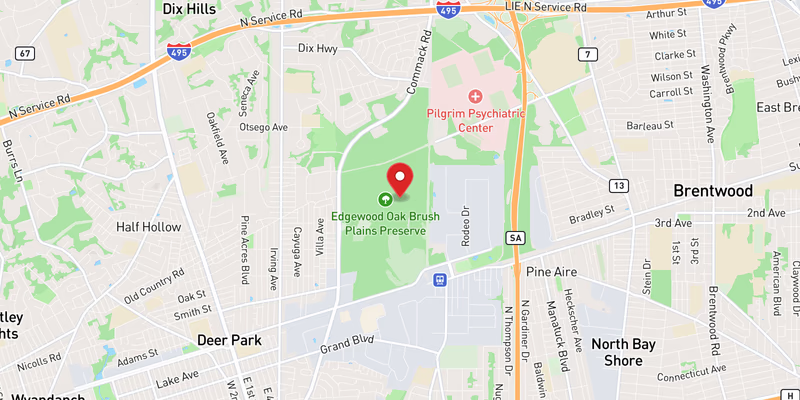
Map showing incident location at 40.7800, -73.3000 Incident location, Long Island

What Happened

Matthew Smith, a 20-year-old man from Hauppauge, is facing more than a dozen additional charges in connection with a drunk driving crash that killed Nassau County Police Officer Patricia Espinosa in Lake Grove on January 31, according to court records. The upgraded charges include aggravated vehicular homicide, marking a significant escalation in the case against Smith, who prosecutors say had more than twice the legal limit of alcohol in his system at the time of the fatal collision.

The deadly crash occurred around 6 a.m. on that Saturday morning when Smith’s vehicle slammed into Officer Espinosa’s car, according to authorities. The 42-year-old officer was on her way to work at Nassau County’s fifth precinct in Elmont when her vehicle was struck. Prosecutors say Smith had been driving at speeds up to 125 miles per hour before the impact that claimed Espinosa’s life.

According to News 12’s reporting, the sequence of events leading to the crash began when Smith left a Patchogue bar and then drove to Jake’s 58 casino in Islandia. This information comes from Smith’s passenger, John Andali, who was in the vehicle during the fatal journey. The timeline shows Smith’s movements across multiple Long Island locations before the deadly collision in Lake Grove.

Blood alcohol testing revealed that Smith’s level was more than double the legal limit of 0.08 percent, though specific BAC numbers were not disclosed in court documents. The combination of excessive speed and severe intoxication created the deadly conditions that led to Officer Espinosa’s death as she was simply commuting to her shift at the Nassau County Police Department’s fifth precinct.

The crash represents a tragic loss for the Nassau County Police Department, as Officer Espinosa was killed while traveling to serve her community. The fact that she was struck during her commute to work underscores the random nature of drunk driving fatalities, where innocent victims are killed by impaired drivers who make the decision to get behind the wheel.

Smith’s passenger, Andali, has apparently provided investigators with crucial details about their activities before the crash, including their stops at the Patchogue bar and Jake’s 58 casino. This witness testimony likely plays a significant role in the prosecution’s case, as it establishes Smith’s drinking pattern and movements throughout the night and early morning hours leading up to the fatal collision.

Location & Road Context

The fatal collision occurred in Lake Grove, a hamlet in Suffolk County on Long Island’s South Shore. Lake Grove sits at the intersection of several major roadways and is located between the more populated areas of Ronkonkoma to the north and Bohemia to the south. The area where the crash occurred would have been part of Officer Espinosa’s commute from Suffolk County to Nassau County, where she worked at the fifth precinct in Elmont.

The route from Lake Grove to Elmont typically involves traveling west through Suffolk County into Nassau County, a common commute pattern for Long Island residents who work in different counties than where they live. The early morning timing of the crash, around 6 a.m. on a Saturday, would have meant relatively light traffic conditions, which may have contributed to Smith’s ability to reach the excessive speeds of up to 125 mph that authorities say he achieved before the impact.

Smith is now facing an expanded indictment that includes more than a dozen additional charges beyond his original charges, with the most serious being the upgraded charge of aggravated vehicular homicide. This represents a significant escalation from typical vehicular manslaughter charges and reflects the severity of the circumstances, including Smith’s extreme intoxication level and excessive speed.

The defendant is scheduled to be arraigned on the new indictment on Friday, where he will formally hear the additional charges against him. The upgraded charges suggest that prosecutors have gathered additional evidence since the initial arrest and believe they can prove the more serious allegations in court. Aggravated vehicular homicide carries substantially harsher penalties than lesser vehicular crimes and reflects the prosecution’s view of the egregious nature of Smith’s conduct.

Broader Impact

The upgraded charges in this case highlight New York State’s aggressive approach to prosecuting drunk drivers who kill others, particularly when extreme circumstances like excessive speed and severe intoxication are involved. Aggravated vehicular homicide can carry sentences of up to 25 years in prison, reflecting the state’s recognition that drunk driving deaths represent preventable tragedies that warrant serious criminal consequences for those who choose to drive while severely impaired.

Topics

ElmontNassau CountyNassau County accidentElmont trafficElmont accidentserious accidentDWI crashLong Island accident todayLong Island traffic todayLong IslandNY

Frequently Asked Questions

What should I do if I'm in a car accident in Elmont?

Call 911 immediately if anyone is injured or if the vehicles can't be moved safely off the roadway. Stay at the scene — leaving the scene of an accident with injuries is a crime under New York Vehicle and Traffic Law §600. Exchange license, registration, and insurance information with every other driver involved. Take photographs of every vehicle, the position of the vehicles before they're moved, all license plates, the road surface, traffic signs, and any visible injuries. Get the names and phone numbers of every witness — police often won't capture bystander witnesses on their own. Seek medical attention within 24 hours even if you feel fine; soft-tissue injuries and concussions can take a day or two to present, and a delayed medical visit weakens an injury claim. NCPD generally responds to accidents on Nassau County roads outside of incorporated villages with their own police forces (e.g., Garden City, Freeport). For state highways (I-495 LIE, Northern State Parkway, Southern State Parkway, Meadowbrook Parkway, Wantagh Parkway), New York State Police Troop L responds.

How long do I have to file a no-fault claim in New York?

Thirty days. New York Insurance Law §5102 requires you to file a Personal Injury Protection (PIP/no-fault) application with the insurer of the vehicle you were in (or, if you were a pedestrian or cyclist, with the insurer of the striking vehicle) within 30 days of the accident. Missing the 30-day deadline can void your no-fault benefits — that's up to $50,000 in medical bills and 80% of lost wages (capped at $2,000/month) per injured person. The form is the NF-2 application; your insurance carrier provides it on request. New York no-fault is a true PIP system: it pays regardless of who caused the crash.

What counts as a "serious injury" under New York law?

Under Insurance Law §5102(d), a "serious injury" is one that meets at least one of these categories: (1) death; (2) dismemberment; (3) significant disfigurement; (4) a fracture; (5) loss of a fetus; (6) permanent loss of use of a body organ, member, function, or system; (7) permanent consequential limitation of use of a body organ or member; (8) significant limitation of use of a body function or system; or (9) a medically determined injury that prevents the injured person from performing substantially all daily activities for at least 90 of the first 180 days following the accident. Only injuries that meet one of these nine categories create the right to sue the at-fault driver for pain and suffering damages — short of that threshold, recovery is limited to no-fault PIP benefits. Disputes over whether an injury meets the threshold are the single most-litigated issue in NY motor-vehicle cases.

How long do I have to sue after a Long Island car accident?

Three years from the date of the accident for personal injury claims under CPLR §214(5). Wrongful death claims have a two-year deadline under EPTL §5-4.1. If a government entity is involved (a county vehicle, a road defect on a state highway, a defective traffic signal, a county bus), you must file a Notice of Claim within 90 days under General Municipal Law §50-e — that's a non-negotiable jurisdictional deadline, and missing it usually bars the claim entirely. Property-damage-only claims have the same three-year clock. The clock starts on the day of the accident, not the day you discover the full extent of an injury.

Can I still recover compensation if I was partly at fault?

Yes. New York is a pure comparative negligence state under CPLR §1411. Even if you were 90% at fault, you can still recover 10% of your damages. (A pending 2026 budget proposal would change this to a 51% bar — meaning a plaintiff who is more than 50% at fault would recover nothing — but that hasn't passed.) Insurance carriers routinely try to inflate the injured driver's percentage of fault to reduce payouts. The percentage assignment is decided by the jury at trial (or negotiated during settlement); it isn't fixed by the police accident report and isn't binding even when the report assigns fault. Reporting practice and the actual legal apportionment are separate questions.

Who can file a wrongful death claim in New York?

Under EPTL §5-4.1, only the personal representative (executor or administrator) of the deceased's estate can bring a wrongful death action — not the deceased's family directly. The estate is opened in Surrogate's Court of the county where the deceased lived. Damages flow to the spouse, children, parents, and other distributees defined under EPTL §4-1.1. Recoverable damages include loss of financial support, loss of parental guidance for surviving children, and conscious pre-death pain and suffering (recovered through a separate "survival action" under EPTL §11-3.2). New York is unusual in NOT allowing surviving family members to recover for their own emotional grief — only economic losses to the estate. The wrongful-death two-year statute of limitations is shorter than the three-year personal-injury statute, so the deadline is critical.

How do I get a copy of the police accident report?

If Nassau County Police Department (NCPD) responded to the scene, the report is filed under an MV-104A form. In New York State, you can request a copy through the DMV at https://dmv.ny.gov/vehicle-safety/get-copy-accident-report (roughly $7 online, $10 by mail) once the responding agency has uploaded it to the state system, which usually takes 5-10 business days. NCPD and SCPD also have their own direct-request processes through the precinct that responded. If you weren't injured but the property damage exceeded $1,000, New York VTL §605 requires you (the driver) to file your own MV-104 report with the DMV within 10 days regardless of whether police responded.

How dangerous is This Road near Elmont?

Long Island Traffic tracks every reported incident on this road across both counties — see the road profile page for the multi-year accident count, severity distribution, and the specific intersections that show repeated incident clusters. Suffolk and Nassau county roads with chronic problems are reviewed by their respective DOTs on a multi-year cadence; persistent issues are sometimes addressed with new signal phasing, lane-narrowing treatments, or — in extreme cases — a Vision Zero engineering response. Daily incident updates flow into our live-events feed every fifteen minutes.

Disclaimer: Incident information on this page is compiled from public sources including police reports, traffic agencies, and news outlets. It is provided for informational purposes only and may not reflect the most current status of this incident. Do not rely on this information for legal, insurance, or emergency decisions. For emergencies, call 911.